
AI music tools are everywhere right now. Suno, Udio, Soundraw, Mubert – you can type a few words and get a full track in seconds, for free or close to it. For creators who have spent hours hunting for the right background music, it sounds almost too good to be true.
But here’s the thing most AI music tools don’t put in their marketing: AI-generated music can still trigger YouTube copyright claims. It can get your video demonetized, flagged by Content ID, or create legal exposure you didn’t see coming – even when the tool called it “free” or “royalty-free.”
Before you drop an AI track into your next video and hit upload, here’s what you actually need to understand. The legal landscape is still unsettled, the copyright situation is murkier than most tools let on, and a wrong call here can cost you monetization, views, or your channel.
This post isn’t here to tell you AI music is evil. It’s here to give you a real, honest picture – the risks, the grey areas, the tools, and the alternatives – so you can make a smart decision for your channel.
Quick Answer
AI music can be used on YouTube, but it is not automatically safe. Tools that label their music “free” or “royalty-free” can still generate Content ID claims on your videos – sometimes from the tool company itself, not a record label. The copyright status of AI-generated music is legally unsettled, YouTube’s policies on AI audio are actively changing, and the tools that seem safe today may operate under different rules next quarter.
For creators who want clear, documented copyright protection without the guesswork, licensed music from real artists remains the straightforward choice.
Table of Contents
- What Is AI-Generated Music?
- Is AI Music Copyright-Free?
- The Honest Pros and Cons of AI Music for Creators
- AI Music vs. Licensed Music from Real Artists: Side-by-Side
- Music That’s Safe, Trending, and Made by Real Artists
- Which AI Music Tools Are Creators Actually Using in 2026?
- How to Stay Safe If You Do Use AI Music
- FAQs
- Conclusion
What Is AI-Generated Music?
AI-generated music is exactly what it sounds like: music created by an artificial intelligence model rather than a human musician. Tools like Suno, Udio, Soundraw, and Mubert let you describe what you want – “upbeat lo-fi hip hop for a morning vlog” or “cinematic orchestral tension build” – and the AI generates a full track, often in seconds.
The results have gotten genuinely impressive. In 2024 and 2025, the gap between AI-generated music and human-produced tracks narrowed considerably. Some AI music now rivals the production quality of professional stock tracks. For creators who need something functional fast, that’s a real appeal – and it’s worth acknowledging honestly.
What separates AI music from traditional royalty-free or licensed music is the absence of a human creator behind the final work. That distinction sounds simple, but it has significant legal and practical consequences that every creator should understand.
Is AI Music Copyright-Free?
This is the question every creator is asking – and the honest answer is: it depends, and it’s more complicated than most tool websites suggest.
“AI-generated” does not automatically mean “copyright-free.” In fact, AI music exists in a legal grey zone that touches on three separate questions: who (if anyone) owns the music you made with the tool, what rights the tool’s company retains, and whether the AI’s training data creates any downstream exposure for you as a user.
Who Owns the Copyright to AI-Generated Music?
In the United States, copyright law requires human authorship. The U.S. Copyright Office published a detailed report on this in early 2025, concluding clearly that works generated entirely by AI – without meaningful human creative contribution – cannot be protected by copyright. Providing a text prompt alone does not constitute sufficient human authorship to qualify for copyright protection.
What this means practically: if you use an AI tool to generate a track and you didn’t contribute meaningful creative expression to the output, the music may not be copyrightable by anyone – including you. That sounds freeing, but there’s a catch. The tool provider may still claim rights under their terms of service, and “no copyright protection” is not the same as “no risk.”
It’s also worth noting that if a human musician layers their own creative decisions on top of an AI output – making specific arrangement choices, editing, adding original elements – the human-contributed portions may qualify for some copyright protection. The Copyright Office analyzes these situations case by case.
The Training Data Problem
Here’s the risk that often goes unmentioned: most AI music tools were trained on enormous datasets of existing music. The critical question is whether that music was licensed. In many early cases, it wasn’t.
In June 2024, Sony Music, Universal Music Group, and Warner Records filed major copyright infringement lawsuits against Suno and Udio, alleging that both platforms used copyrighted recordings without authorization to train their AI models. By late 2025, both Suno and Udio had reached partial settlements – Suno struck a deal with Warner Music Group, and Udio settled with both Warner and UMG. As of early 2026, Sony’s case against Udio is still ongoing.
Both companies have committed to retiring their current models and launching new versions trained exclusively on licensed content. That’s progress – but those new models aren’t fully in place yet, and the legal proceedings are a reminder that the foundation on which these tools were built is still being litigated.
Why does this matter for you as a creator? Because when you use a tool trained on unlicensed music, there is at least a theoretical downstream risk. The legal consensus on exactly how that risk flows to end users hasn’t been fully established – but it’s an active area of litigation, and the landscape may shift. Independent artist Anthony Justice also filed complaints against both Suno and Udio in 2025 on behalf of a group of musicians. This is not a settled area of law.
What Happens If You Use AI Music on YouTube?
YouTube’s Content ID system identifies music by audio fingerprint – it doesn’t know or care whether a track was made by a human or an AI. The question it asks is: has this audio been registered in the Content ID database?
This creates a scenario that surprises many creators. Some AI music tool providers have registered their own generated music with Content ID. That means if you use their music in your video, your video could still receive a Content ID claim – even though you used the tool’s output exactly as intended. The claim would come from the tool company, not a record label.
YouTube’s policies on AI-generated content have been evolving through 2025 and into 2026. As of now, YouTube requires disclosure labeling for AI-generated content, and music without clear human authorship documentation may face restrictions on monetization eligibility. Content ID claims on AI music are unpredictable – they can result in revenue being redirected, a video being blocked in certain territories, or in the worst cases, a YouTube copyright strike if a dispute is rejected.
The core problem is unpredictability. Policies are changing, legal cases are ongoing, and the tool you use today may operate under different rules next quarter.
The Honest Pros and Cons of AI Music for Creators
Let’s put it plainly. There are real reasons creators are drawn to AI music, and there are real reasons to be cautious.
The Pros
- Affordability. Many AI music tools offer free tiers or very low-cost subscriptions.
- Speed. A full track in seconds is genuinely useful when you’re up against a deadline.
- Customization. You can dial in mood, tempo, energy, and instrumentation using simple text prompts.
- No per-track fees. Unlike some licensing platforms, you’re not paying per song.
- No attribution required in most cases, depending on the tool’s terms.
The Cons
- Legal grey zone. The copyright status of AI-generated music is genuinely unsettled, both in terms of ownership and training data liability.
- Inconsistent Content ID behavior. Your video may get claimed even when you’ve technically followed the tool’s terms – because the tool provider has registered their outputs with Content ID themselves.
- Evolving YouTube policies. The rules around AI music disclosure, monetization eligibility, and content labeling are still being written. What’s permissible today may not be next year.
- Quality ceiling. AI music has improved dramatically, but it can still feel generic or lack the distinctiveness that helps a video stand out.
- No artist story or connection. Music made by real independent artists carries energy, intention, and a human story. That authenticity can come through in your content – and it matters to audiences.
- Retroactive risk. As laws evolve and legal cases resolve, the risk profile of AI music may change retroactively for content that’s already published.
AI Music vs. Licensed Music from Real Artists: Side-by-Side
| Feature | AI Music | Licensed Music (like Thematic) |
|---|---|---|
| Copyright clarity | Murky – AI outputs may not be copyrightable; tool terms vary widely | Clear – human-authored tracks with documented licenses |
| Content ID risk | Unpredictable – some tools register their own outputs in Content ID | Minimal – Thematic tracks come with lifetime licenses and no Content ID claims |
| Platform coverage | Varies by tool and plan – read terms carefully for YouTube, TikTok, Instagram | Explicitly covers YouTube, TikTok, Instagram, and more |
| Music quality/authenticity | Improving rapidly, but often generic; no human intent behind the track | Real artists, real creative intent – often trending tracks with genuine audience appeal |
| Artist support | None – no human creator benefits from your use of the track | Direct – independent artists gain exposure and new fans every time their music is used |
| Cost | Free to low-cost on many tools; paid plans required for full commercial rights | Free with promo link in description; no subscription required |
| Creator community | No community component | 1M+ creator community; collaborative ecosystem |
Music That’s Safe, Trending, and Made by Real Artists
If you’re tired of second-guessing whether your background music is going to trigger a claim, there’s a straightforward answer: use music where the license is clear, documented, and built for creators.
That’s exactly what Thematic offers. Thematic is built around real independent artists – not an AI generator, not a prompt-to-track tool. You get lifetime licenses that cover YouTube, TikTok, Instagram, and podcasts, which means no takedowns, no surprise claims, and no policy changes that suddenly put your old videos at risk.
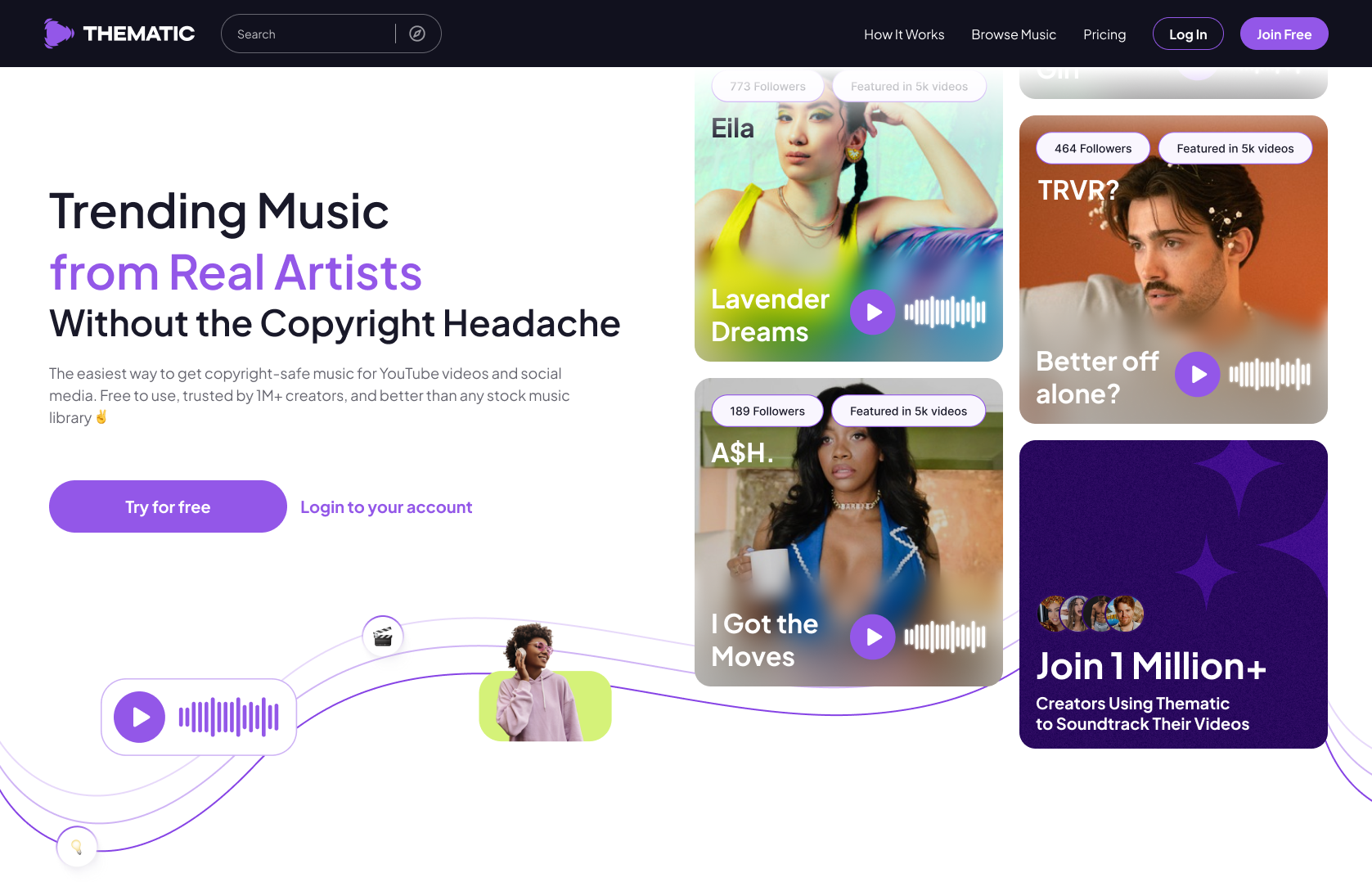
What makes Thematic different isn’t just the legal safety – it’s the music itself. These are trending tracks from artists who are actively building their audiences. When you use Thematic music, you’re not just protecting your channel; you’re part of something bigger. Artists get real promotion through creator videos. Creators get music that actually resonates.
1M+ creators in 220+ countries are already using Thematic to soundtrack their content without the stress.
No complicated licensing terms. No surprise claims. Just great music from real artists who want to be heard.
Which AI Music Tools Are Creators Actually Using in 2026?
If you do decide to use AI music, knowing the specific terms and risks of each tool matters a lot. Here’s a factual overview of the main platforms.
Suno
Suno was one of the first AI music generators to gain mainstream attention and remains one of the most capable tools for generating full, production-quality tracks from text prompts. After settling its lawsuit with Warner Music Group in late 2025, Suno has committed to training future models exclusively on licensed content. Free-tier tracks are not downloadable and are shareable only; paid-tier users get limited monthly download caps. Commercial licensing terms for YouTube use are available under paid plans, but creators should read the current terms carefully as the platform transitions to its new licensed model. Suno has also registered some of its generated content with Content ID, which can lead to unexpected claims.
Udio
Udio settled lawsuits with Warner Music Group and Universal Music Group in 2025. As part of its settlement terms, Udio has pivoted significantly – moving from a general AI music generator toward a fan engagement platform focused on remixing and mashing up licensed music within a closed ecosystem. Creations currently cannot leave the platform for use in external content. This makes Udio substantially less useful for YouTube creators looking for background music. Sony’s lawsuit against Udio remains ongoing as of early 2026.
Soundraw
Soundraw operates on a subscription model and offers explicit commercial licenses for YouTube under its Creator and Artist plans. The platform states that all music created on Soundraw is cleared for commercial use, and it prohibits users from registering Soundraw-generated music with Content ID – which is a meaningful consumer protection compared to some competitors. This doesn’t eliminate the training data questions that apply to any AI music tool, but Soundraw’s licensing language is more creator-friendly than many alternatives. Paid plans start at a monthly fee; verify current pricing and terms at soundraw.io.
Mubert
Mubert generates adaptive, streaming AI music rather than fixed downloadable tracks. Under its Render subscription plans, Mubert offers royalty-free commercial licenses that cover YouTube monetization. Like other AI tools, the underlying copyright questions around training data apply, and creators should verify current terms for their specific use case, including platform coverage for TikTok and Instagram.
Epidemic Sound’s AI Tools (Studio and Adapt)
Epidemic Sound is an established licensed music platform that launched AI-powered tools in late 2025 – notably Studio, which auto-soundtracks videos using AI matching against Epidemic Sound’s existing licensed catalog, and Adapt, which lets creators customize human-made tracks using AI tools. Crucially, Epidemic Sound’s AI tools work on top of their licensed music library, not on top of AI-generated content trained on unlicensed data. This positions their approach differently from pure AI generators. Epidemic Sound has its own Content ID situation for tracks registered by its artists, and it operates on a subscription model. Their approach is worth understanding as an example of how AI tools can be built on a licensed foundation.
How to Stay Safe If You Do Use AI Music
If you’ve weighed the options and decide AI music is right for your workflow, here’s how to minimize your risk as a creator.
Read the terms of service before you use a single track. This is not optional. Look specifically for: whether commercial use is permitted, which platforms are explicitly covered (YouTube, TikTok, Instagram – don’t assume), whether monetization is included, and whether the tool has registered any content with Content ID.
Pay for the plan that includes commercial rights. Free tiers on AI music tools almost never include full commercial licenses. If you’re monetizing your channel, you need a paid commercial plan – and even then, verify the terms in writing.
Keep records of what you used and when. Screenshot or save the licensing terms, your subscription status, and the specific track at the time you publish. If a claim comes in six months later, you’ll need that documentation.
Check whether the tool has registered content with Content ID. This is a specific question worth asking or looking up in the platform’s FAQ. If a tool has registered its outputs in Content ID, you may receive a claim regardless of your license – because the claim comes from the tool provider, not a third party.
Stay current on platform policies. YouTube’s rules on AI music disclosure and monetization eligibility are actively evolving. Check YouTube’s Help Center periodically if you’re relying on AI music for your channel.
Consider whether the peace of mind is worth the savings. For many creators, the time and mental energy spent monitoring AI music tool terms, responding to claims, and staying ahead of policy changes outweighs the cost of a straightforward licensed music solution. That’s a real calculation worth making.
🧠 For a deeper understanding of how copyright works on YouTube and how to protect your channel, those fundamentals apply whether you’re using AI music or any other source. You can also read our guides on royalty-free music, using copyrighted music on YouTube, and finding the best music for YouTube videos.
FAQs about using AI Music in Videos
Let’s answer some of the most asked questions about using AI music in videos posted to YouTube.
Is AI-generated music safe to use on YouTube?
It depends on the tool and the plan. Some AI music platforms offer explicit commercial licenses that cover YouTube monetization – Soundraw’s paid plans are an example. However, even with a commercial license, there are unresolved questions around training data liability, and YouTube’s policies on AI music are still evolving. “Safe” is a relative term here, and no AI music tool currently offers the same legal clarity as a properly licensed track from a human artist with documented rights.
Can AI music get copyright claimed on YouTube?
Yes – and this surprises many creators. YouTube’s Content ID system identifies music by audio fingerprint, not by origin. If an AI music tool has registered its generated outputs with Content ID (which some do), your video using that music may still receive a claim from the tool provider. Additionally, if an AI track was trained on copyrighted music and resembles the original closely enough, a rights holder could potentially assert a claim.
Who owns the copyright to AI music?
This is genuinely unsettled law. In the U.S., the Copyright Office’s 2025 report concluded that purely AI-generated works do not qualify for copyright protection because they lack human authorship. However, the tool provider may retain rights under their terms of service, and if a human makes meaningful creative contributions to an AI output, those specific contributions may be copyrightable. The practical answer: the copyright ownership of AI music is unclear, which is itself a risk factor.
Is AI music royalty free?
Not automatically. “Royalty free” is a licensing term – it means you pay once (or not at all) and don’t owe ongoing royalties per use. Some AI music tools offer royalty-free licenses under paid plans. But AI-generated origin alone doesn’t make music royalty free; the tool’s terms of service determine that. Always check whether your specific plan includes commercial, royalty-free use for the platforms where you publish. You can read more about what royalty-free music actually means in our guide to royalty-free music.
Will YouTube demonetize videos with AI music?
Possibly, under certain circumstances. YouTube’s evolving AI content policies include disclosure requirements for AI-generated audio, and videos with undisclosed AI-generated music may face monetization restrictions. A Content ID claim from any source – including an AI tool’s own registered content – can also redirect ad revenue away from the creator. And if a claim escalates into a YouTube copyright strike, the consequences are more serious. None of this is guaranteed to happen, but the risk is real.
What’s the difference between AI music and royalty-free music?
AI music refers to how the music was created – by an artificial intelligence rather than a human musician. Royalty-free music refers to a licensing model – you pay once and can use the music without ongoing royalties. These are completely separate concepts that often get confused. You can have royalty-free AI music (if the tool offers that license) or non-royalty-free AI music. You can also have royalty-free human-made music (which is what Thematic offers) or human-made music that requires ongoing royalties. The origin of the music and the licensing terms are two different things.
Is Thematic music AI-generated?
Thematic is built on music from real independent artists, and the platform actively filters out AI-generated submissions. The vast majority of the catalog is human-made. That said, some artists do use AI as part of their creative process, and as with any platform, not every submission can be perfectly screened. What Thematic is not is an AI music generator – there is no tool on the platform that creates music from prompts, and the model is built around real artists who want their music heard by real audiences.
Conclusion
The AI music conversation is still evolving – legally, technically, and creatively. New tools are launching, lawsuits are settling, policies are being written and rewritten. That’s genuinely exciting to watch. And some AI music tools are putting in the work to build on licensed foundations, which is an encouraging direction for the industry.
But your channel doesn’t have to wait for the law to catch up.
The safest music for your videos is music with a clear, documented license from a real source – music you can point to and say “I have the rights to use this, here’s the documentation, here’s the license.” That clarity protects you today and every day your video stays up.
If you want that peace of mind alongside music that’s trending, high quality, and made by artists who genuinely benefit when you use it – that’s exactly what Thematic is built for.
Start free at hellothematic.com and find your next track without the second-guessing.
Related reading:
- What Is Royalty-Free Music?
- How to Use Copyrighted Music on YouTube
- How Copyright Works on YouTube
- Best Music for YouTube Videos
- What Is a YouTube Copyright Strike?
Looking for more free creator tools and resources? Visit Thematic’s Creator Toolkit for additional resources on creating content – including thumbnail and channel art templates, best practices, and of course, great royalty free songs to use in your videos for free with Thematic.

This guide on Is AI Music Safe to Use on YouTube? is brought to you by Thematic Co-Founder & COO Audrey Marshall
With a background in entertainment PR (via Chapman University), Audrey has led digital strategy for music artists, content creators, and brands. From brand campaigns for Macy’s, American Cancer Society, and the L’Oréal luxe family of brands, to music-driven influencer marketing campaigns for Interscope Records, Warner Music, AWAL, and Taboo of the Black Eyed Peas (featuring creators such as Lexy Panterra, Blogilates, Mandy Jiroux, Matt Steffanina, and Seán Garnier), she is an expert in navigating the influencer marketing space. Audrey has also developed and managed some of the leading beauty, lifestyle, and dance channels on YouTube.
Certified across the board with YouTube, Audrey has a specific focus on digital rights management for music assets, running multiple SRAV-enabled CMS. She is passionate about working with other builders in the space for a more transparent digital rights ecosystem.
At Thematic, Audrey leads the product team and oversees operations. She has driven partnerships with leading talent and music companies, including Songtrust, Kobalt/AWAL, Select Management, BBTV, ipsy, and Black Box, and has helped the platform grow to a thriving community of 1M+ content creators who have posted 1.6M+ videos using the platform, driving 60B+ music streams and $120M+ in earned media value for independent music artists.