
Quick Answer:
In the US, every original song is copyrighted the moment it is created – automatically, no registration required. To check a specific track, use YouTube’s Copyright Checks screen during upload (most practical for creators), search the US Copyright Office database at copyright.gov, or look up the song in an ASCAP, BMI, or SESAC database.
👉 Keep in mind: confirming that a song is copyrighted only tells you it’s protected. It doesn’t tell you whether you’re allowed to use it. For that, you need a license.
If you’ve ever hesitated before adding a track to your video – wondering “wait, is this song copyrighted?” – you’re not alone. It’s one of the most common questions creators ask, and the answer is both simpler and more complicated than most people expect.
The short version: assume every song is copyrighted unless you can prove otherwise. In the US, copyright protection is automatic from the moment a song is created. There’s no filing required, no registration needed, no paperwork to check off. A bedroom producer’s unreleased demo is just as legally protected as a chart-topping hit. That’s your starting point.
The longer version is what this guide covers: how to actually check, what the results mean, and what to do next.
Table of Contents
- The default rule: assume it’s copyrighted
- 5 methods to check if a specific song is copyrighted
- Finding out a song is copyrighted doesn’t mean you can use it
- What “copyright-free” and “royalty-free” actually mean
- Copyright registration vs. Content ID: not the same thing
- Public domain explained: compositions vs. recordings
- The practical alternative for creators
- FAQs
- Conclusion
The Default Rule: Assume Every Song Is Copyrighted
US copyright law (and most international frameworks through the Berne Convention) automatically protects original creative works at the moment of creation. A song doesn’t need to be registered, published, or commercially released to be copyrighted.
This means:
- A song recorded in someone’s living room last week is copyrighted.
- A track uploaded to SoundCloud with no label behind it is copyrighted.
- An old song you can’t find any information about is almost certainly still copyrighted.
The burden is on you to prove a song is safe to use, not on the rights holder to prove it isn’t. That’s a critical mindset shift for creators who assume “I couldn’t find who owns it, so it must be free to use.”
👉 For a deeper explanation of how copyright works on YouTube specifically, see our guide: How Copyright Works on YouTube.
5 Methods to Check If a Specific Song Is Copyrighted
None of these methods will give you a definitive “yes, you can use this” answer on their own. What they will do is help you understand the copyright status and ownership of a track so you can make an informed decision about licensing.
Method 1: YouTube’s Copyright Checks (Most Practical for Creators)
If you’re making YouTube videos, this is the first place to check – not because it’s the most legally thorough, but because it’s the most practically useful.
Where to find it: The Checks screen, which appears during the YouTube upload process. Before you publish, YouTube runs a copyright check on your video and surfaces any issues it finds. You can review results, remove claimed content, or dispute a claim before the video goes live – or publish and fix issues afterward since checks run in the background.
What it shows you: The Copyright check scans your video for copyrighted content registered in YouTube’s Content ID system. If a match is found, the rights holder’s policy is applied: they can monetize the video (claiming your ad revenue), track its performance, or block it in certain regions.
Why it matters: You find out before publishing rather than after. If there’s an issue, you have options – remove the flagged content, swap the track, or dispute the claim – before your video is live.
⚠️ The big caveat: Check results aren’t final. Future manual Content ID claims, copyright strikes, or edits to your video settings can still affect your video after it publishes. And a clean check doesn’t mean the song is safe to use freely – it only means no rights holder has currently enrolled it in Content ID. They could still file a manual claim later. A clean check is not a license.
Method 2: US Copyright Office Search (copyright.gov)
For an official copyright registration check, the US Copyright Office maintains a public database at copyright.gov.
What it covers: Works formally registered with the US Copyright Office. This database is especially thorough for works registered after 1978 and for older works where formal registration was required under the previous copyright system.
How to use it: Search by title, artist name, or claimant. You can filter by type of work (sound recording, musical composition, etc.) and date range.
Limitations:
- Registration is not required for copyright protection, so many songs – especially independent releases – won’t appear here at all, and are still fully protected.
- The database is more useful for verifying ownership details (so you know who to contact for a license) than for confirming whether a song is safe to use.
- The interface is technical and can be slow to navigate.
🏆 Best for: Researching who owns a song’s rights when you want to license it directly, or investigating older works where formal registration was common.
Method 3: PRO Databases – ASCAP, BMI, SESAC
Performing Rights Organizations (PROs) manage public performance royalties for songwriters and publishers. Most commercially released songs are registered with one of the three major US PROs.
- ASCAP (American Society of Composers, Authors and Publishers) – search at ascap.com/repertory
- BMI (Broadcast Music, Inc.) – search at repertoire.bmi.com
- SESAC – smaller and invite-only; search at sesac.com
⭐️ Start with Songview: ASCAP and BMI jointly built Songview (songview.com), a unified search engine that reconciles ownership data from both organizations in one place. The system ingests song ownership information, processes it against agreed-upon rules, and returns reconciled data including songwriters and their affiliations, publisher data, performers, alternate song titles, and ISWC and IPI codes. Songs where ASCAP and BMI agree on the information appear with a green checkmark. This is the most efficient starting point for ASCAP and BMI repertoire.
For SESAC, search separately at sesac.com.
What PRO databases tell you: The song title, songwriter(s), publisher(s), and which PRO manages the performance rights. This is useful for identifying who owns the rights and how to contact them.
What they don’t tell you: Whether you have permission to use the song. Being in a PRO database confirms the song is actively managed for royalties, which means it’s copyrighted and someone is paying attention to its use.
🗒️ One thing to note: These are US-based organizations. For international music, check the equivalent in that country – PRS in the UK, SOCAN in Canada, APRA AMCOS in Australia.
Method 4: Identify an Unknown Song with Shazam, Then Research
Sometimes the problem isn’t checking copyright – it’s that you don’t even know what the song is called. Maybe you heard it in someone’s video, in a store, or in a playlist and want to track it down.
Step 1 – Identify the song: Use Shazam to identify the track by holding your phone near the audio. The app is free and returns results in seconds. Google’s built-in Search can also identify songs – tap the microphone icon and select “Search a song.”
Step 2 – Research from there: Once you have the song title and artist, run it through YouTube’s Checks screen (upload the video to a private draft first) and Songview or the PRO databases above.
This method doesn’t check copyright directly – it’s just the necessary first step when you don’t have enough information to search anything. Identification gives you the details you need to run the real checks.
Method 5: The Public Domain Date Test
Some songs are genuinely free to use because copyright protection has expired. These works are in the “public domain” – no one owns them and you don’t need a license.
The general rule for the US (as of 2026): Compositions (the melody and lyrics) published before 1928 are generally in the public domain. That puts us at roughly 98 years ago as the threshold.
👉 Important: this is more complicated than it sounds.** The date test applies to the composition, not necessarily to any specific recording of it. See the full section on public domain below for the details that matter most to creators.
When this method is useful: Classical music, traditional folk songs, and very old compositions. For anything from the 20th century or later, don’t rely on this test alone.
Finding Out a Song Is Copyrighted Doesn’t Mean You Can Use It
This is the step that trips up a lot of creators.
Going through all the methods above and confirming that a song is copyrighted only tells you one thing: the song is protected. It tells you nothing about whether you have permission to use it.
To legally use a copyrighted song in your video, you need a license – explicit permission from the rights holder (or a platform they’ve authorized to grant permission on their behalf) to use the work under specific conditions.
For most YouTube creators, you’d need a sync license to use music in a video, plus a master use license to use the specific recording (as opposed to commissioning a cover version). The process of obtaining these directly from major rights holders is notoriously difficult and expensive for independent creators.
👉 The practical takeaway: checking copyright status is necessary, but it’s only step one. Step two is finding a path to a license – which is where most people either get stuck or give up and use the track anyway (a choice that carries real risk).
For a full breakdown of your licensing options, see: How to Use Copyrighted Music on YouTube.
What “Copyright-Free” and “Royalty-Free” Actually Mean
These two terms get used constantly in creator communities, and both are misleading.
“Copyright-free” is technically inaccurate almost every time you see it. Music described as “copyright-free” almost always means the creator has made it available under a free or open license – not that copyright doesn’t apply. The creator still owns the copyright. They’re just granting you permission to use it under certain conditions. Those conditions vary widely, so always read the specific terms rather than assuming “copyright-free” means unrestricted use.
“Royalty-free” doesn’t mean free, and it doesn’t mean there’s no copyright. It means you pay once for a license and don’t owe additional royalties each time you use the track. Stock music libraries and licensing platforms typically operate on a royalty-free model – you pay for a subscription or a one-time license, and you can use the music without paying per use. The copyright remains with the creator; you’ve just pre-paid your usage rights.
Neither term means “use without consequence.” Both should prompt you to find the actual license terms before you use the music.
Copyright Registration vs. Content ID: Not the Same Thing
These are two completely separate systems, and mixing them up leads to real problems.
Copyright registration is an optional formal process handled by the US Copyright Office. It provides certain legal advantages – like the ability to sue for statutory damages – but copyright protection exists automatically, with or without registration.
Content ID is YouTube’s proprietary content management system. Rights holders submit audio and video content to YouTube, which then scans every uploaded video for matches. When a match is detected, the rights holder’s policy (monetize, track, or block) is applied automatically.
🧐 Why this distinction matters to creators:
A song doesn’t need to be in Content ID to be copyrighted. Many independent artists and smaller rights holders never enroll in Content ID, but they still own full copyright protection. If they find out you used their track without permission, they can file a manual copyright claim – which can have the same impact as a Content ID flag, or worse.
Going the other direction: a song can appear in Content ID even if the person who submitted it isn’t the original rights holder. Fraudulent Content ID claims are a known problem on YouTube. This is one reason why documented licenses matter – they give you a paper trail to dispute bad claims.
👉 For what to do if you’re already dealing with a copyright claim, read: So You Received a Copyright Claim on Your YouTube Video.
Public Domain Explained: Compositions vs. Sound Recordings
The public domain rule sounds simple. It’s not, and missing the nuance can get creators into trouble.
A song has two separate copyrights: one for the composition (the melody and lyrics) and one for the specific sound recording (the actual recorded performance you’d use in a video). These two copyrights can expire at very different times.
- Composition copyright: In the US, compositions published before 1928 are generally in the public domain as of 2026. If the underlying song – the melody, chord progression, and lyrics – was published before that date, you can cover it, transcribe it, or use a new recording of it without needing a license for the composition.
- Sound recording copyright: This is where most creators get surprised. Sound recordings made before 1972 in the US were governed by state law rather than federal copyright, and many are still protected for decades more. Even a recording of a public domain composition can be fully under copyright.
A concrete example: Beethoven’s compositions are in the public domain – he died in 1827. But a recording of Beethoven’s 9th Symphony made by a modern orchestra last year is not. The recording is a separate creative work with its own copyright. If you want to use that specific recording in your video, you need permission from whoever owns the master.
The practical rule: Finding a “public domain” composition doesn’t automatically mean any recording of it is safe to use. Always trace both the composition and the specific recording you’re planning to use.
👉 For more on the YouTube Audio Library as a source of cleared recordings, see: YouTube Audio Library: What It Is and When to Use It.
Stop Worrying About Copyright – Start Creating with Licensed Music
Here’s the honest reality of researching individual song copyrights: it takes time, requires checking multiple databases, and even when you do everything right, confirmation that a song is copyrighted still doesn’t give you permission to use it. You still need a license – and for most mainstream music, getting one is either impossible or too expensive for independent creators to pursue.
The most practical alternative isn’t to research individual tracks more thoroughly. It’s to use a platform where the licensing work is already done for you.
Thematic is a free music platform built specifically for creators. Every track on Thematic comes from real independent artists who have submitted their music because they want it used in creator content. The license is pre-cleared and tied directly to each video you publish.
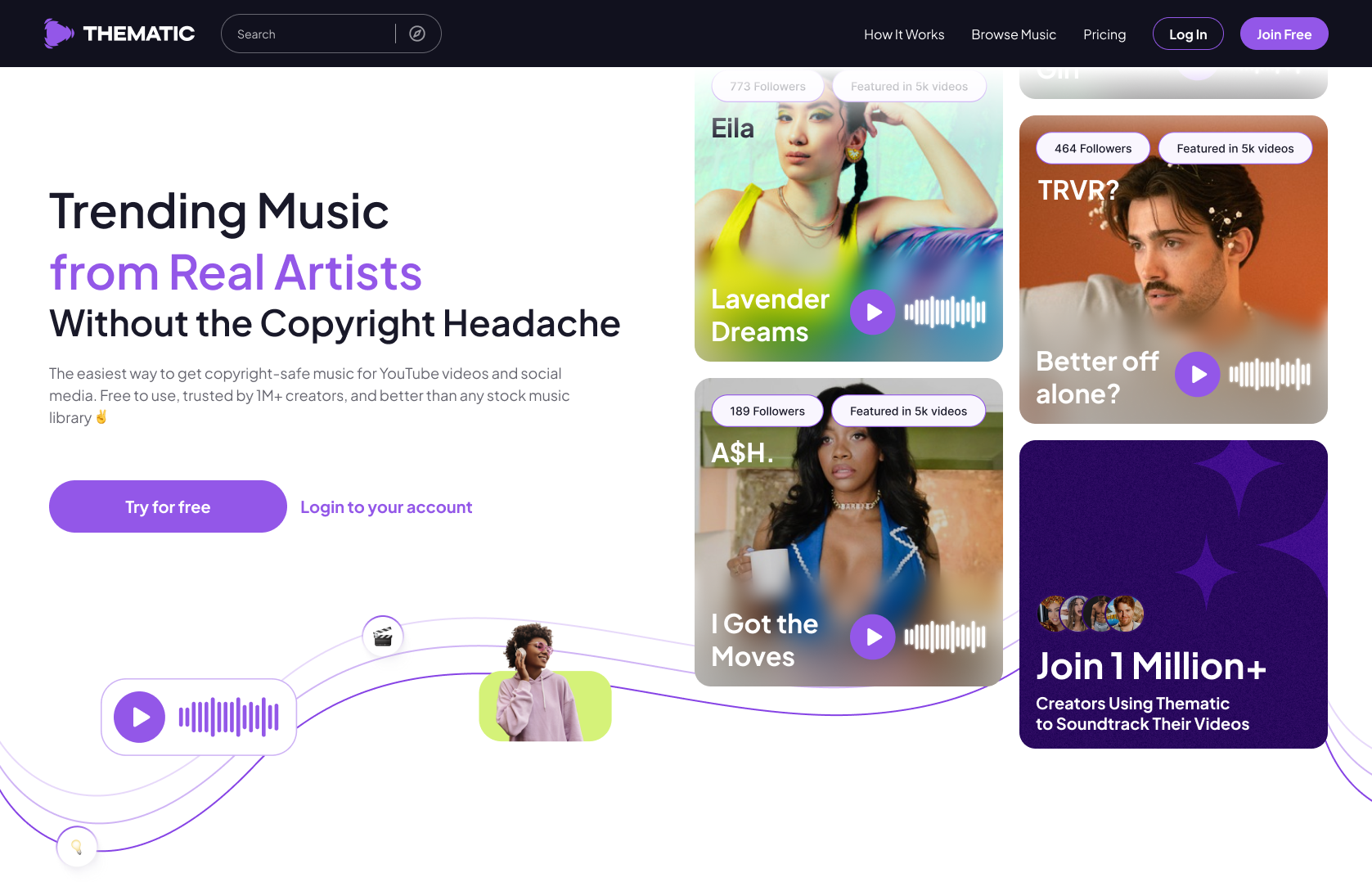
Here’s what makes Thematic different from most music libraries:
- The license link does real work. When you add the Thematic link to your video description, it activates documented legal protection for that specific video. You always have a record of your right to use the track – per video, per platform. That documentation matters if a claim ever comes up.
- Free tier, no subscription required. You don’t need to pay to access the music or the protection. The free tier is permanent, with no download caps and no attribution requirement beyond the description link.
- Real independent artists, no AI-generated music. Artists submit to Thematic because creator exposure is genuinely valuable to them. The catalog reflects what real creators want, because Thematic creators actually vote on which songs get added.
- Get promoted as you publish. Every video you publish with a Thematic track gets featured across the Thematic platform – driving new viewers to your content. No other music platform does this.
Instead of spending time in copyright databases for one track, spend that time making your video – with music you know is cleared.
👉 For more on where creators find music and the trade-offs of each option, see: Where Do YouTubers Get Their Music? and Best Free Music Websites for Creators.
FAQs About Song Copyrights
Let’s answer some of the most asked questions about music, copyright, and finding out if a song is copyrighted!
Is every song automatically copyrighted?
Yes. In the US and most countries (under the Berne Convention), original songs are automatically protected by copyright from the moment they are created – no registration, no filing, no public notice required. Assume every song is copyrighted unless you can definitively prove it’s in the public domain or under a license that permits your specific use.
How do I check if a song is copyrighted on YouTube?
Use YouTube’s Checks screen, which runs automatically during the upload process. Upload your video (you can set it to private or unlisted), let the Copyright check run, and review any issues before publishing. The check scans for content registered in YouTube’s Content ID system and tells you what action the rights holder has set. Keep in mind: a clean result isn’t final – future manual claims or changes to your video settings can still affect it later.
What happens if I use a copyrighted song without permission?
If the song is registered in Content ID, your video will be automatically flagged. The rights holder can then claim your ad revenue, track your video’s performance, or block it in certain countries. If the song isn’t in Content ID, the rights holder can still file a manual copyright claim with similar consequences. Repeated violations can affect your channel standing, and three copyright strikes can result in channel termination.
Does “royalty-free” mean I can use a song for free?
Not necessarily. Royalty-free means you pay once for a license and don’t owe ongoing royalties – but there is still a copyright, and there may still be an upfront cost. Always check the specific license terms. “Royalty-free” is a pricing model, not a statement about whether copyright applies.
Can I use a song if I can’t find who owns it?
No. Songs where the rights holder can’t be identified are still protected by copyright. Not being able to find the owner doesn’t grant you a license to use the work – it means you have no clear path to getting one. Treat unidentifiable ownership as a reason to find a different track, not as permission to proceed.
What is the public domain and how do I know if a song qualifies?
The public domain is the set of creative works no longer protected by copyright. In the US, compositions published before 1928 are generally in the public domain as of 2026. However, the specific sound recording of a public domain composition may still be fully protected – especially recordings made after 1972. Always check both the composition and the recording separately before assuming a track is free to use.
What’s the difference between ASCAP, BMI, and SESAC?
All three are Performing Rights Organizations (PROs) that collect and distribute performance royalties for songwriters and publishers. Each manages a different membership. Most commercially released US songs are registered with one of the three. You can search each organization’s public database to find which PRO manages a specific song and who holds the publishing rights – useful information if you’re trying to license a track directly.
Is a song copyrighted if it’s not registered with ASCAP or BMI?
Yes. PRO registration is about collecting performance royalties, not about establishing copyright. A song is copyrighted at creation regardless of whether it appears in any PRO database, Content ID, or the Copyright Office’s records. An absence from these systems means the creator may handle rights independently – not that the song is unprotected.
What does it mean if YouTube’s Copyright Check shows no issues?
It means no rights holder has currently enrolled that song in Content ID, so there’s no automated policy being applied. It does not mean the song is in the public domain, or that you have a license to use it. The rights holder could enroll the song in Content ID later, or file a manual claim after you’ve published. A clean check is a status, not a permission.
What’s the easiest way to avoid copyright problems with music in my videos?
Use a platform where every track comes pre-cleared with a documented license. Platforms like Thematic provide music from independent artists who have explicitly authorized creator use. The license is tied to each video you publish, giving you documented proof of your permission per video – on YouTube, TikTok, Instagram, and podcasts. Start for free on Thematic.
Can I get in trouble for using a song even if the rights holder doesn’t seem to care?
Potentially, yes. Copyright enforcement isn’t always immediate. Rights holders also change – a song can be acquired by a label or publisher that actively pursues claims. “They haven’t come after me yet” is not legal protection. A documented license gives you a paper trail regardless of who holds the rights or when they decide to act.
Conclusion
the research methods above – YouTube’s Copyright Checks, copyright.gov, PRO databases, Shazam identification, and the public domain date test – give you the tools to understand the status of any specific track.
But understanding status is only half the equation. The other half is getting permission, which means getting a license. For most creators, the most reliable path to both clarity and legal protection is using pre-cleared music from a platform built for that purpose.
Thematic was built around this exact problem. Our co-founder Michelle Phan experienced a copyright strike firsthand, and Thematic was designed from the ground up so creators never have to wonder whether their music is safe to use. Every track comes with a license, every license links to your video, and the whole thing is free to start.
Looking for more free creator tools and resources? Visit Thematic’s Creator Toolkit for additional resources on creating content – including thumbnail and channel art templates, best practices, and of course, great royalty free songs to use in your videos for free with Thematic.

This guide on How to Find Out if a Song is Copyrighted is brought to you by Thematic Co-Founder & COO Audrey Marshall
With a background in entertainment PR (via Chapman University), Audrey has led digital strategy for music artists, content creators, and brands. From brand campaigns for Macy’s, American Cancer Society, and the L’Oréal luxe family of brands, to music-driven influencer marketing campaigns for Interscope Records, Warner Music, AWAL, and Taboo of the Black Eyed Peas (featuring creators such as Lexy Panterra, Blogilates, Mandy Jiroux, Matt Steffanina, and Seán Garnier), she is an expert in navigating the influencer marketing space. Audrey has also developed and managed some of the leading beauty, lifestyle, and dance channels on YouTube.
Certified across the board with YouTube, Audrey has a specific focus on digital rights management for music assets, running multiple SRAV-enabled CMS. She is passionate about working with other builders in the space for a more transparent digital rights ecosystem.
At Thematic, Audrey leads the product team and oversees operations. She has driven partnerships with leading talent and music companies, including Songtrust, Kobalt/AWAL, Select Management, BBTV, ipsy, and Black Box, and has helped the platform grow to a thriving community of 1M+ content creators who have posted 1.6M+ videos using the platform, driving 60B+ music streams and $120M+ in earned media value for independent music artists.