
Quick Answer:
Not always – and the risk is more specific than most creators realize. Most music labeled “no copyright” still has a copyright owner; the phrase means it’s free to use under certain conditions, not that it’s unprotected.
The bigger danger is retroactive Content ID claims: songs that appear safe when you download them can be registered in YouTube’s Content ID system later, automatically triggering claims on every video that used them (including ones you published months or years ago). Whether “no copyright music” is actually safe depends entirely on how the license is structured and whether someone is actively managing the rights on your behalf.
If you’ve searched YouTube for music and found channels or tracks labeled “no copyright music,” “copyright free,” or “free to use,” you’ve probably assumed that label means you’re protected. In most cases, it means something much more limited – and for a lot of creators, the gap between what they assumed and what was actually true shows up as a copyright claim on a video they thought was safe.
This guide breaks down what “no copyright music” actually means, where the real risk comes from, and what it takes to keep your videos protected for good.
Table of Contents
- What “no copyright music” actually means
- The real risk: retroactive Content ID claims
- How safe is each type of “no copyright” source?
- Why “no copyright” doesn’t always mean “no claims”
- What actually protects a video from copyright claims
- The practical solution for creators
- FAQs about “no copyright music”
- Conclusion
What Does “No Copyright Music” Actually Mean?
The phrase “no copyright music” is used inconsistently across YouTube, and that inconsistency is where most of the confusion starts.
In practice, it usually means one of three things:
1. Free to use under specific terms. The creator has made their music available at no cost, but under conditions – usually requiring a credit in your video description, restricting commercial use, or limiting which platforms the music can appear on. The copyright still belongs to the creator. They can still register it in Content ID and claim your video if you don’t follow their terms exactly.
2. Creative Commons licensed. Creative Commons is a standardized set of licenses that let creators share their work with defined permissions. A CC BY license requires attribution. CC BY-NC restricts commercial use. CC0 releases all rights. Not all Creative Commons music is safe for all uses – a CC BY-NC track used in a monetized YouTube video is technically a license violation, even if the track was labeled “free.”
3. Public domain. Genuinely unprotected music where copyright has expired or was never established. In the US, compositions published before 1928 are generally in the public domain. This is the only category where “no copyright” is literally accurate – but it applies to compositions, not necessarily to specific recordings of them, and it’s rarer than the label suggests.
👉 The bottom line: “No copyright music” is a marketing label, not a legal status. Always find the actual license terms before you use any track, regardless of how it’s described.
The Real Risk: Retroactive Content ID Claims
This is the thing most creators don’t know about until it happens to them.
YouTube’s Content ID system doesn’t scan music once at the time of upload and then leave your video alone. It’s an ongoing database. Rights holders (or their distributors) can register new content at any time. When they do, YouTube’s system retroactively scans all existing videos and applies the registered policy to every video containing that audio.
👉 What this means in practice: A track you downloaded from a “no copyright music” YouTube channel six months ago may have had no Content ID registration at the time. Your video published fine, no claims. But if the creator, their distributor, or even a third party later registers that track in Content ID, YouTube will automatically flag your video – and every other video using that song. You did nothing wrong. The music’s rights situation changed after you used it.
Thematic has observed this pattern repeatedly in creator support interactions. Creators arrive having done everything right – found music labeled “free to use,” credited the artist, followed the terms – and still received claims months later when the rights situation changed. The frustration is real. The problem is not creator error. It’s a structural gap between “free to download” and “protected in perpetuity.”
This risk is not theoretical. YouTube’s Content ID database contains over 100 million assets and grows continuously as distributors upload catalogs on behalf of artists and labels. Independent artists who previously shared music freely often sign with distributors later in their careers – and those distributors register everything in Content ID as a standard part of the deal. A creator with years of videos using free music can see claims appear across dozens of videos simultaneously because of a single signing.
🧠 For a deeper breakdown of how Content ID works, see: How Copyright Works on YouTube
How Safe Is Each Type of “No Copyright” Music Source?
Not all “no copyright” sources carry the same risk. Here’s what each one actually means for your channel.
| Source | What “Free” Actually Means | Retroactive Claim Risk | Monetization Risk |
|---|---|---|---|
| NoCopyrightSounds (NCS) | Free to use on YouTube with credit – NCS claims ad revenue via Content ID | Low (consistent policy, well-managed) | High – NCS claims monetization even with proper credit |
| YouTube Audio Library | Free to use; some tracks require attribution | Low to medium – a small number of tracks have had rights changes | Low for most tracks |
| Creative Commons (Free Music Archive, ccMixter) | Varies by license type – CC BY, CC BY-NC, CC0 | Medium – rights can change as artists sign deals | Medium – CC BY-NC not valid for monetized videos |
| Pixabay Music | Free with simple license | Medium – retroactive registration possible as artists grow | Low if terms followed |
| Random “no copyright” YouTube channels | Varies – ownership often unclear or disputed | High | High |
| Thematic | Pre-cleared license per video, actively managed in Content ID | Very low – Thematic administers rights, resolves issues directly | Protected – license documented at the video level |
The NCS (NoCopyrightSounds) situation is worth understanding specifically
NCS is one of the most popular free music sources on YouTube, and many creators assume “no copyright” means their videos are safe. What it actually means is that NCS has agreed not to block your video – but they register their music in Content ID and will claim your ad revenue. For creators in the YouTube Partner Program, using NCS music means giving up monetization on any video that includes it. There’s no strike risk if you credit correctly, but the financial trade-off is significant and the “no copyright” label doesn’t make that clear.
Why “No Copyright” Doesn’t Always Mean “No Claims” on YouTube
There are two gaps between “no copyright music” and actual claim protection that creators regularly encounter.
Gap 1 – Content ID is YouTube’s system, not the artist’s
A music creator can offer their music for free use and simultaneously register it in Content ID. These two things are not mutually exclusive. Many “no copyright music” channels do exactly this – they allow free use under their terms, but still use Content ID to enforce those terms, claim monetization, or track usage. Offering music for free doesn’t opt it out of Content ID.
Gap 2 – Third parties can register music they don’t own
A distributor, publisher, or rights management company can register music in Content ID that they don’t legitimately own – either in error or fraudulently. When this happens, creators who legally used the music still receive claims. Having a documented license is what lets you dispute these successfully. Using music with no license documentation leaves you with no evidence when a dispute arises.
👉 For what to do if you already have a claim on your channel, see: So You Received a Copyright Claim on Your YouTube Video
What Actually Protects a Video From Copyright Claims
Three things determine whether a video is genuinely protected over the long term:
1. A documented license tied to the specific video. “Free to use” is not a license. A license is a documented agreement that grants you permission to use a specific work under defined terms, creating a record you can reference if a claim is disputed. A link in your description, a license certificate, or a license number tied to the video are all forms of documentation. A download with no paper trail is not.
2. Active rights management by the platform you licensed from. The most reliable protection isn’t just having a license at the moment of use – it’s being covered by a platform that monitors Content ID, resolves claims when they occur, and stands behind the licenses it issues. If a rights situation changes after you use the music, you want a team whose job it is to fix it – not the creator on their own trying to dispute a claim with no documentation.
3. License terms that don’t expire or depend on a continued subscription. Some platforms’ licenses are only valid while you maintain a paid subscription. Cancel and your past videos may be at risk for new content claims. A license tied to the specific video – not to an account status – is structurally more durable.
👉 For a full comparison of your licensing options, see: How to Use Copyrighted Music on YouTube
The Practical Solution: Music With Actual Protection
The problem with the “no copyright music” ecosystem isn’t that the creators offering free music are being dishonest. Most of them are sharing genuinely. The issue is structural – free music with loose terms, no documentation, and no ongoing rights management can’t guarantee protection because the rights environment on YouTube changes constantly.
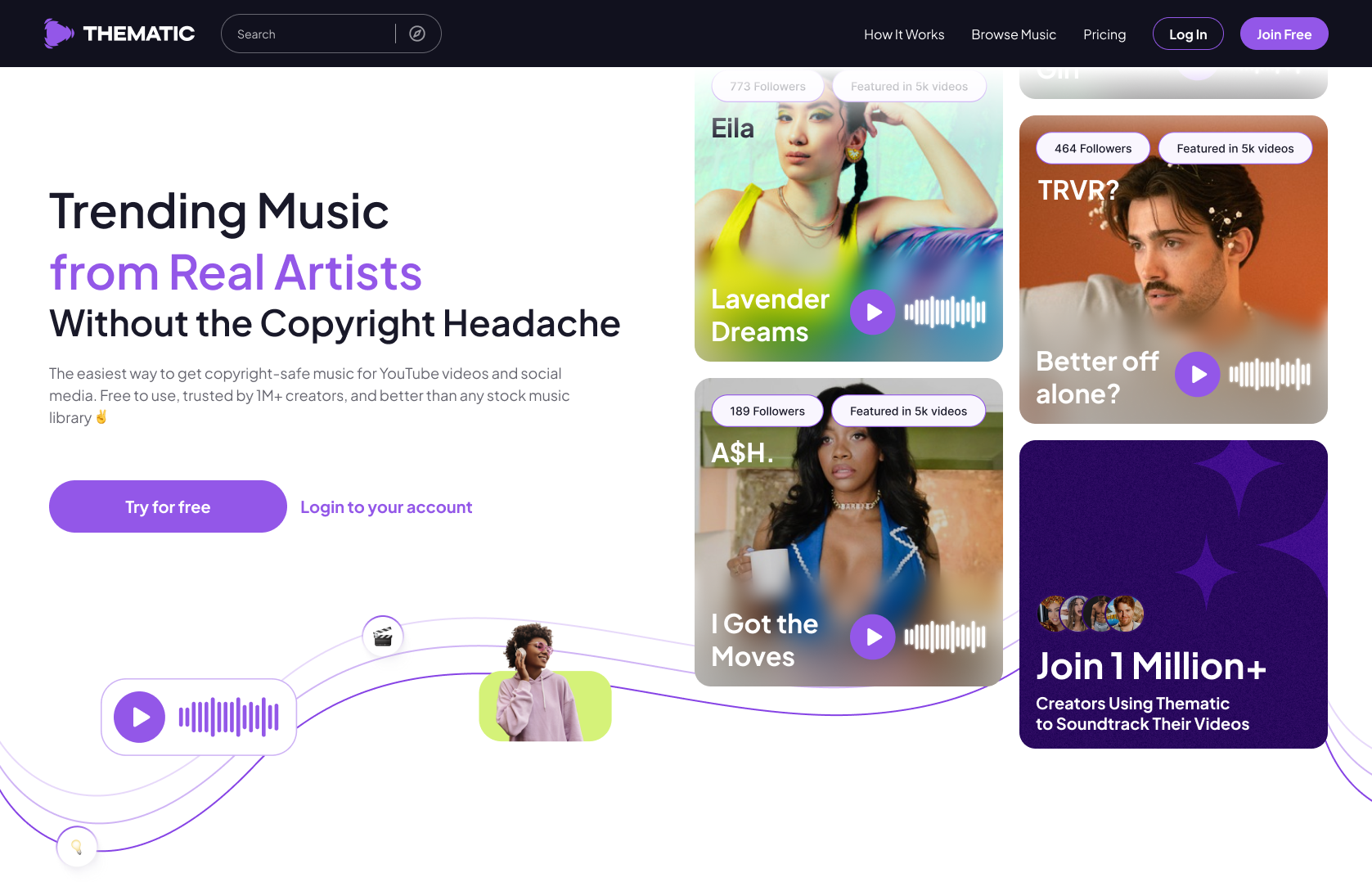
Thematic was built specifically to close that gap. Every track comes with a pre-cleared license that is:
- Documented at the video level. The license link in your description is both your proof of license and the signal to Content ID that the video is covered. Not a download with no trail – a documented, video-specific record that can be referenced in any dispute.
- Actively managed in Content ID. Thematic administers its catalog in YouTube’s Content ID system directly. If a rights situation changes, Thematic’s team resolves it – creators don’t have to navigate disputes alone.
- Permanent, not subscription-dependent. Thematic’s free tier has no subscription to cancel. Every video published with the license link in the description stays protected regardless of account status going forward.
Thematic’s co-founder Michelle Phan experienced a copyright strike firsthand in 2015, and the platform was designed from the ground up so that outcome wouldn’t happen to the creators using it.
👉 For a full roundup of free music options and how each one handles Content ID, see: Best Free Music Websites for Creators
FAQs about no copyright music
Let’s answer some of the most asked questions about using “no copyright music.”
Is no copyright music actually free to use?
Free to download, but not always free to use without conditions. Most “no copyright music” still has a copyright owner who has set specific terms – credit requirements, platform restrictions, or commercial use limits. Always read the license terms before using any track, regardless of how it’s labeled.
Can I get a copyright claim for using no copyright music?
Yes. A copyright claim can occur if the music is registered in YouTube’s Content ID system and the rights holder has applied a monetize, track, or block policy. Some “no copyright music” channels actively use Content ID to claim ad revenue on videos that use their music – NoCopyrightSounds is a well-known example. Others have no current Content ID registration but may be added later, which triggers retroactive claims on past videos.
Why did I get a copyright claim on music I downloaded for free?
The most common cause is retroactive Content ID registration. The track had no Content ID admin when you downloaded and used it, but the rights holder or their distributor registered it later. YouTube’s system then scanned existing videos and applied the claim. Thematic has observed this pattern repeatedly – it’s one of the most common reasons creators switch to a platform with active rights management.
Is YouTube Audio Library music safe to use?
Generally yes – it’s one of the safer free options because Google controls both the library and the YouTube platform. A small number of Audio Library tracks have had rights changes over time, and some require attribution. Always check the specific track’s terms before using it. See: YouTube Audio Library: What It Is and When to Use It
Is NCS (NoCopyrightSounds) music actually copyright free?
No – the name is misleading. NCS owns the copyright to music in their catalog and actively uses Content ID. Their policy allows free use on YouTube if you credit them in the description, but NCS will claim the ad revenue on any video using their music. Your video won’t be blocked or struck, but you won’t earn ad revenue from it. For monetized creators, “no copyright” in this case means “no strike risk” – not “no cost.”
What’s the difference between copyright free, royalty free, and no copyright music?
These terms are used inconsistently. In general:
- copyright free means available for use under specific conditions, not literally unprotected;
- royalty free means you pay once (or nothing) and don’t owe per-use royalties, but copyright still applies;
- no copyright means either genuinely public domain or, more commonly, free to use with conditions.
None of these terms guarantee protection from Content ID claims. Only a documented license from a platform with active rights management does.
What happens to my videos if the artist whose music I used signs a record deal?
When an independent artist signs with a label or distributor, their catalog is typically registered in Content ID as part of the deal. If you used that artist’s music when it was freely available, and they sign later, you may receive retroactive Content ID claims on videos you thought were safe. The only structural protection against this is using music from a platform that actively manages rights and will step in if the situation changes.
How do I know if music is actually safe to use on YouTube?
Check three things:
- Does the license explicitly permit use on YouTube, including monetized videos if your channel is monetized;
- Is the license documented in a way you can reference if a claim is disputed;
- Is a platform actively managing the rights on an ongoing basis, so a change in registration status doesn’t retroactively affect your videos.
Music that passes all three is genuinely safe. Music that fails any of them carries risk.
Conclusion
“No copyright music” describes a spectrum of risk, not a guarantee of safety. The phrase can mean anything from genuinely public domain music to commercially managed catalogs that claim your monetization if you miss a credit. The retroactive Content ID problem makes the risk ongoing: music that was safe when you used it can become a problem later through no fault of your own.
Real protection means a documented license, active rights management, and terms that don’t depend on the music’s registration status staying unchanged. That’s what Thematic was built to provide – free for creators, with every video covered by a documented, video-level license that doesn’t expire.
Related reading:
- How Copyright Works on YouTube – full breakdown of Content ID, claims, and strikes
- How to Use Copyrighted Music on YouTube – six legal methods compared
- So You Received a Copyright Claim on Your YouTube Video – how to resolve a claim you already have
- How to Find Out if a Song Is Copyrighted – five methods for checking any track before you use it
- Best Free Music Websites for Creators – full roundup of free music options and their trade-offs
Looking for more free creator tools and resources? Visit Thematic’s Creator Toolkit for additional resources on creating content – including thumbnail and channel art templates, best practices, and of course, great royalty free songs to use in your videos for free with Thematic.

This guide on Is No Copyright Music Safe to Use on YouTube? is brought to you by Thematic Co-Founder & COO Audrey Marshall
With a background in entertainment PR (via Chapman University), Audrey has led digital strategy for music artists, content creators, and brands. From brand campaigns for Macy’s, American Cancer Society, and the L’Oréal luxe family of brands, to music-driven influencer marketing campaigns for Interscope Records, Warner Music, AWAL, and Taboo of the Black Eyed Peas (featuring creators such as Lexy Panterra, Blogilates, Mandy Jiroux, Matt Steffanina, and Seán Garnier), she is an expert in navigating the influencer marketing space. Audrey has also developed and managed some of the leading beauty, lifestyle, and dance channels on YouTube.
Certified across the board with YouTube, Audrey has a specific focus on digital rights management for music assets, running multiple SRAV-enabled CMS. She is passionate about working with other builders in the space for a more transparent digital rights ecosystem.
At Thematic, Audrey leads the product team and oversees operations. She has driven partnerships with leading talent and music companies, including Songtrust, Kobalt/AWAL, Select Management, BBTV, ipsy, and Black Box, and has helped the platform grow to a thriving community of 1M+ content creators who have posted 1.6M+ videos using the platform, driving 60B+ music streams and $120M+ in earned media value for independent music artists.