
A release decision made without listener input is a guess. A well-informed guess, maybe – drawing on years of A&R experience, catalog pattern matching, and gut feel – but still a guess.
The music industry has always known this. The challenge has been finding a fast, affordable, and music-specific way to get real listener signal before a release goes out. Traditional consumer research panels move slowly, cost a lot, and were not designed with music listening behavior in mind. The workarounds – internal listening sessions, social media polls, Spotify for Artists data – all have significant blind spots.
This post covers what good music testing actually looks like before a release, why most general research tools fall short, and what a music-specific listener panel can give you that nothing else does.
Table of Contents
- Why Pre-Release Testing Matters
- The Problem with General Research Panels
- What Good Music Listener Research Looks Like
- The Questions Worth Asking Before a Release
- Get Real Listener Feedback with Soundcheck
- FAQs
- Conclusion
Why Pre-Release Testing Matters
The decisions that most benefit from pre-release listener input are the ones that are hardest to reverse.
Cover art is a commitment. A release title is a commitment. Release timing relative to a cultural moment, the marketing angle for a campaign, which track leads a project – these are all decisions that shape how a release lands, and most of them get made before a single fan has heard the music.
Post-release data is abundant. Streaming numbers, save rates, playlist adds, social engagement – there is no shortage of signal once a song is out. The problem is that by then, the decisions that might have benefited from that signal have already been made. You are optimizing what is left, not shaping what launches.
Pre-release testing does not replace judgment. It informs it. A track that tests unexpectedly well with listeners in a territory you had not prioritized is a data point worth having. A song that generates consistent confusion about genre or mood – across hundreds of real listeners – is worth understanding before the campaign is built around an assumption about what it is.
The Problem with General Research Panels
Most research platforms were designed for consumer products. Their panels are broad by design, their targeting is demographic, and their question formats work best for testing brand messages, product concepts, and visual assets.
Music does not fit that model well. The relevant variables for music research are not age and income – they are genre affinity, listening context, cultural territory, and behavioral signals that only emerge from real listening history. A panel respondent who self-identifies as a “music fan” is not the same as someone whose streaming behavior shows a consistent affinity for the specific genre and mood of the track you are testing.
The framing also does not transfer. Consumer survey questions tend toward preference and purchase intent. Music research needs different angles – what does this remind you of, where would you listen to it, who do you think this is made for. Standard panels are not built around those questions, and the answers from respondents who do not have genuine music engagement tend to be thin.
Speed is the other problem. Music release schedules are tight. A research process that takes three to four weeks from brief to results does not fit a world where release windows are short and campaign timing is everything.
What Good Music Listener Research Looks Like
The most useful pre-release research has a few things in common.
The panel reflects real listening behavior. Respondents should be matched on the basis of actual genre affinity and listening history – not self-reported music preferences or broad demographic proxies. A track being tested for a Brazilian Latin market should reach people whose listening behavior reflects engagement with that territory and genre.
The questions are designed for music. What does this remind you of? Would you add this to a playlist – and what would you call that playlist? Who do you think this artist sounds like? These questions yield the kind of qualitative signal that helps a team understand how a track positions itself in the listener’s mental map of music. That is more useful for release strategy than a numeric rating alone.
The turnaround fits the release calendar. Useful research comes back in days, not weeks. By the time a four-week research process concludes, the release decisions it was meant to inform have often already been made under deadline pressure.
The output is actionable. Raw numbers are a starting point. What a label team actually needs is a synthesized read on what the data means – key themes from open-ended responses, how sentiment varied across territories or demographics, and verbatim listener quotes that can inform campaign copy or internal alignment.
The Questions Worth Asking Before a Release
Not every pre-release question requires a full research campaign. But the ones below consistently produce decision-useful signal.
Playlist placement and context. “Would you add this to a playlist? What would you call that playlist?” The answers tell you how listeners are mentally categorizing the track – which informs pitching strategy, playlist targeting, and whether the song’s positioning matches the campaign you are building.
Artist comparison. “Who does this remind you of? What other artists would you put them next to?” A&R teams and music marketers already know how they would answer this question. Listener answers often reveal gaps between how a team hears a track and how an unfamiliar ear places it.
Audience identification. “Who do you think this song is made for? Who would love this the most?” Particularly useful when a track sits between genres or has cross-over potential that the team wants to validate or stress-test.
Seasonal and contextual fit. “Does this feel like a summer song, a winter song, or something else?” Simple questions about context and mood can sharpen campaign timing and playlist outreach strategy.
Open reaction. “What does this song remind you of? Where would you listen to it?” Unconstrained open-ended responses often surface the associations and use cases that structured questions miss – and the most resonant verbatims tend to come from this format.
Get Real Listener Feedback with Soundcheck
Soundcheck by Thematic gives labels and music marketers direct access to real music fans for pre-release and campaign research – targeted by territory, genre affinity, and listening behavior, with results in 7 business days.
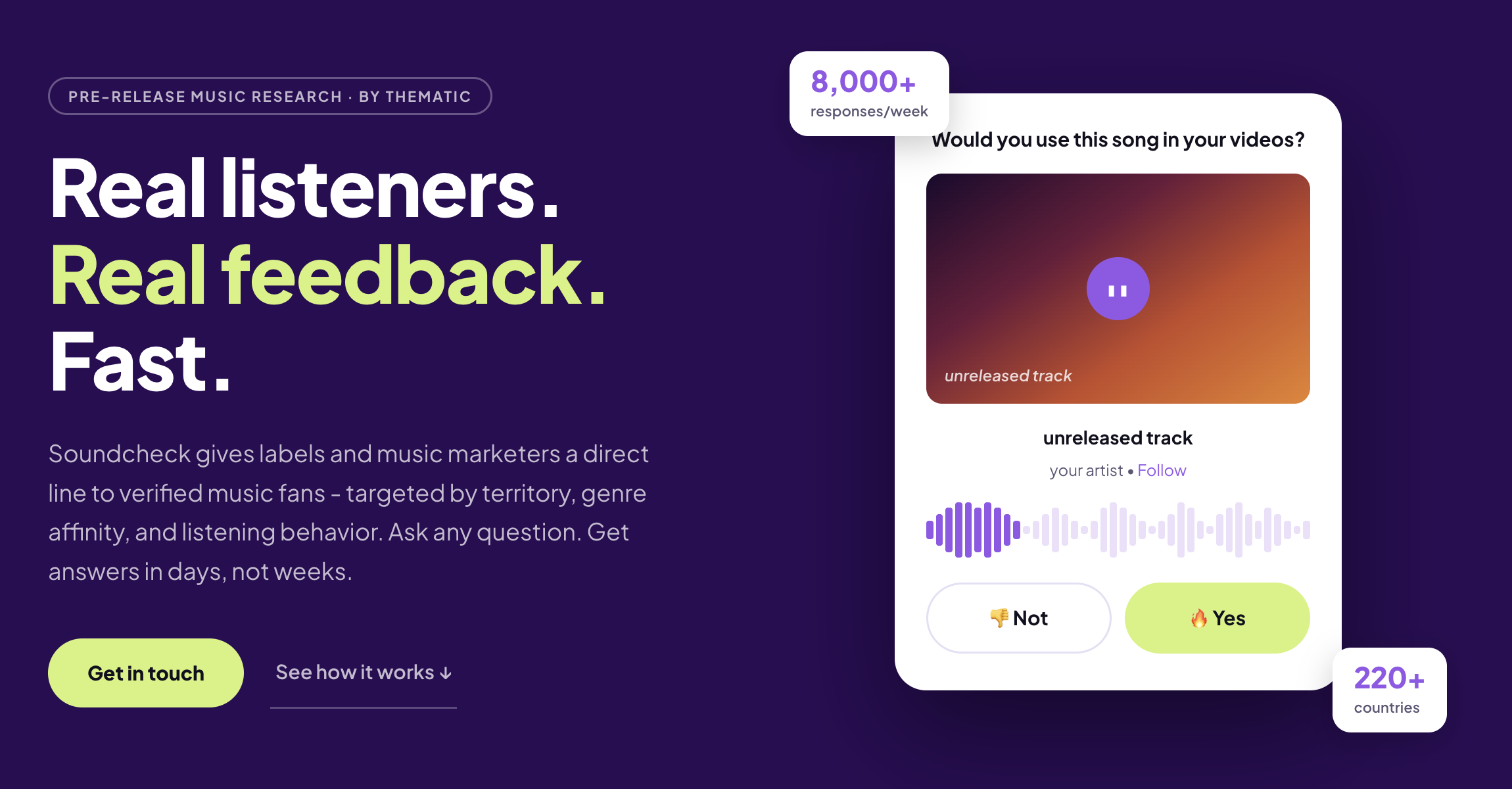
The panel is not a recruited sample. It is Thematic’s existing music community – over 1M music fans who actively engage with tracks through Thematic’s song voting and review system. More than 8,000 listener responses come in every week through that mechanism alone. Soundcheck puts that same panel to work on your release, matched to your target audience using real behavioral data from within the platform.
The output includes a synthesized report with key themes, sentiment breakdown, and standout listener quotes – plus raw response data for teams with internal analysts who want to go deeper. Segment breakdowns show how responses varied by territory or genre affinity, not just overall averages.
Soundcheck is available for select label and music marketing partners. Get in touch at hellothematic.com/soundcheck and we will follow up within one business day.
FAQs
Common questions about pre-release music testing, how listener research works, and what makes Soundcheck different from general research panels.
What is pre-release music testing?
Pre-release music testing is the process of collecting structured listener feedback on a track before it is publicly released. Labels and music marketers use pre-release research to validate release decisions – cover art, title, campaign angle, territory prioritization – and to understand how a track positions itself in listeners’ minds before those decisions are locked in. The goal is to replace assumption with data at the point when data can still influence outcomes.
Why don’t general consumer research panels work well for music?
General panels target respondents by demographic – age, location, income. Music research requires targeting by listening behavior and genre affinity, which demographic proxies do not capture well. A respondent who self-identifies as a music listener is not the same as someone whose actual streaming history reflects engagement with the genre and territory you are testing. General panel question formats also tend not to fit music research well – the most useful music questions are about association, context, and comparison rather than preference and purchase intent.
What kinds of questions can you ask in pre-release music research?
The most decision-useful music research questions tend to be: playlist placement (would you add this, what would you call that playlist), artist comparison (who does this remind you of), audience identification (who do you think this is made for), contextual fit (summer vs. winter, background vs. focus), and open reaction (what does this remind you of, where would you listen to it). These questions yield the qualitative signal that shapes release strategy – not just a numeric score.
How quickly can you get listener feedback on a track?
With a purpose-built music listener panel, meaningful results can come back within days. Soundcheck by Thematic delivers results within 7 business days of receiving a brief. General research platforms vary, but music-specific screening and the specialist question formats involved typically extend timelines significantly.
How is Soundcheck different from streaming pre-save data or social media polls?
Pre-save data tells you about existing fanbase intent – useful, but it reflects people who already know and like the artist. Social media polls reach followers, who are similarly self-selected. Neither tells you how the track lands with listeners who are not already in the orbit of that artist. Soundcheck reaches matched listeners based on genre affinity and listening behavior – people who are predisposed to respond to the music based on what they actually listen to, not because they already follow the artist.
Who is Soundcheck designed for?
Soundcheck is built for A&R teams at indie and major labels, music marketing teams running release campaigns, and music marketers who need real listener data to inform decisions around strategy, positioning, and campaign direction. It is not designed for individual artists looking for informal feedback – the product is built around structured research briefs and synthesized reporting for professional music industry use cases.
Conclusion
The instinct that drives A&R work – the trained ear, the pattern recognition, the feel for what connects – is not something data replaces. But it is something data can sharpen.
The releases that benefit most from pre-release research are the ones with real strategic decisions still to be made: territory priorities not yet locked in, campaign angles not yet chosen, positioning questions still open. The research does not make those decisions. It gives the people making them better information to work with.
Soundcheck by Thematic is built for exactly that moment.
Looking for more free resources and tools for independent artists? Check out Thematic’s Artist Toolkit for a comprehensive collection of tips and best practices on promoting your music. You’ll find guides on music copyright, effective music promotion strategies, and, of course, the best free influencer marketing platform: Thematic, which makes it easy to get your music featured by influencers.

This post on Music Testing Before a Release: What Actually Works is brought to you by Thematic Co-Founder & COO Audrey Marshall
With a background in entertainment PR (via Chapman University), Audrey has led digital strategy for music artists, content creators, and brands. From brand campaigns for Macy’s, American Cancer Society, and the L’Oréal luxe family of brands, to music-driven influencer marketing campaigns for Interscope Records, Warner Music, AWAL, and Taboo of the Black Eyed Peas (featuring creators such as Lexy Panterra, Blogilates, Mandy Jiroux, Matt Steffanina, and Seán Garnier), she is an expert in navigating the influencer marketing space. Audrey has also developed and managed some of the leading beauty, lifestyle, and dance channels on YouTube.
Certified across the board with YouTube, Audrey has a specific focus on digital rights management for music assets, running multiple SRAV-enabled CMS. She is passionate about working with other builders in the space for a more transparent digital rights ecosystem.
At Thematic, Audrey leads the product team and oversees operations. She has driven partnerships with leading talent and music companies, including Songtrust, Kobalt/AWAL, Select Management, BBTV, ipsy, and Black Box, and has helped the platform grow to a thriving community of 1M+ content creators who have posted 1.6M+ videos using the platform, driving 60B+ music streams and $120M+ in earned media value for independent music artists.