
Getting your music heard is harder than making it. You’ve spent months on a track, released it everywhere, and watched the streams trickle in. Meanwhile, a creator posts a video with an independent artist’s song in the background and it reaches a million people by the weekend.
That’s influencer music marketing – and it works because people trust creators. When a creator they follow uses a song in their content, it’s a real endorsement. Listeners aren’t being sold to; they’re just watching a video and noticing the music. That organic discovery is more effective than most paid promotion, and it’s available to independent artists who know how to access it.
Quick Answer
To get your music featured by content creators on YouTube, TikTok, and Instagram, the most scalable approach for independent artists is submitting through a dedicated platform rather than pitching creators individually. Thematic is a free platform that connects independent artists with 1M+ creators – 98% of songs submitted receive at least one creator video placement, with licensing handled automatically and full tracking via an artist dashboard. The four main approaches: listing music as copyright-free (free, but no royalties or tracking), manual outreach to creators directly (relationship-building but hard to scale), paid influencer campaigns (typically $hundreds per placement), and free platforms like Thematic (automated, tracked, no cost to submit).
Table of Contents
- Quick Answer
- What Is Influencer Music Marketing?
- 4 Ways to Get Your Music Featured by Influencers
- How to Submit Music to TikTok Influencers
- Best Practices for Getting Placed
- Submit Your Music to 1M+ Creators for Free
- Frequently Asked Questions
What Is Influencer Music Marketing?
Influencer music marketing is the practice of getting your songs placed in content created by influencers and content creators. Instead of buying playlist placements or running streaming ads, artists reach new listeners through the videos, streams, and posts that creators are already making.
The reason it works: audiences follow creators because they trust their taste. When a creator uses a song in their content – not because they were paid to mention it, but because it fit the moment – the artist behind that song inherits some of that trust. Listeners discover the music the way people have always discovered music: by hearing something they didn’t know they were looking for.
For independent artists, influencer music marketing is one of the most efficient distribution channels available. Artists on Thematic typically see around a 20% increase in Spotify streams after placement activity begins, because the discovery compounds – the more creators who use a track, the more listeners encounter it, and the more those listeners go looking for more.
4 Ways to Get Your Music Featured by Influencers
There are four main approaches to influencer music marketing, ranging from free and passive to expensive and hands-on. Each has real tradeoffs.
1. List Your Music as Copyright-Free
Listing your music as “no copyright” or “copyright-free” makes your tracks discoverable to creators actively searching for music that won’t trigger claims on their videos. It’s a passive approach: you make the music available, creators find it on their own.
What works: Creators searching specifically for copyright-free music are motivated users. If your music fits what they’re working on, placements can happen without any outreach on your part.
What doesn’t: You lose control over where and how your music is used, and you lose monetization. Without a licensing structure behind the placement, you can’t track where your music is being used, you can’t collect royalties from those videos, you lose the ability to claim your videos through YouTube’s Content ID, and you have no visibility into the audiences discovering your music. Creators also tend to cycle through copyright-free libraries quickly – today’s placement doesn’t build tomorrow’s relationship.
This approach generates exposure but not insight. If understanding your audience and growing your fanbase matters to you, you’ll hit its ceiling fast.
2. Manual Outreach to Influencers
Manual outreach means finding creators whose content fits your music, and pitching them directly. You identify the right channels, write a message, send your music, and follow up.
What works: When it lands, manual outreach creates real relationships. A creator who chooses to use your music because you made a genuine connection is more likely to use it again and to mention you to their audience.
What doesn’t: The volume required makes this unsustainable for most independent artists. Response rates are low, licensing gets complicated fast (most creators aren’t set up to manage copyright claims on their own), and there’s no tracking or data on how placements perform once you get them. For every placement you secure, you’ve probably spent hours on outreach that went nowhere.
Manual outreach works as a supplement to other strategies – particularly for building relationships with a small number of key creators. As a primary channel, it’s a grind that doesn’t scale.
If your goal is playlist placement specifically rather than creator video placement, see our breakdown of Thematic vs SubmitHub for how the two approaches compare.
3. Paid Influencer Campaigns
Paid influencer marketing platforms (YouTube BrandConnect, AspireIQ, Collabstr, Upfluence, Influencity) let you pay creators to feature your music in specific pieces of content. You set campaign goals, choose creators, and pay for guaranteed placement.
What works: You get control. Paid campaigns let you target specific creators, set deliverables, and align the placement with your release timeline.
What doesn’t: For independent artists, the math rarely works. Campaigns on these platforms typically start at several hundred dollars per placement, and a meaningful campaign requires multiple placements across different audiences. The licensing complexity is also on you – paid campaign platforms don’t manage Content ID, so you’re still responsible for ensuring creators are protected. And without a data layer on top of the placement, you often can’t tell whether the spend drove anything.
Paid campaigns make more sense for artists with label backing or marketing budgets. For most independent artists, the cost per placement is too high relative to the return.
4. Thematic: Free Influencer Music Marketing
Thematic is a free platform that connects independent artists directly with a community of 1M+ content creators across YouTube, TikTok, and Instagram. Artists submit their music to the platform. Creators discover it, license it, and feature it in their videos. Licensing is handled automatically – no outreach required, no claim risk for the creator, and full tracking for the artist.
Artists who have built careers with help from Thematic include Nicky Youre (whose song “Sunroof” started gaining traction on Thematic before becoming a mainstream hit), ODESZA, JP Saxe, BENEE, Lovelytheband, and MAX.
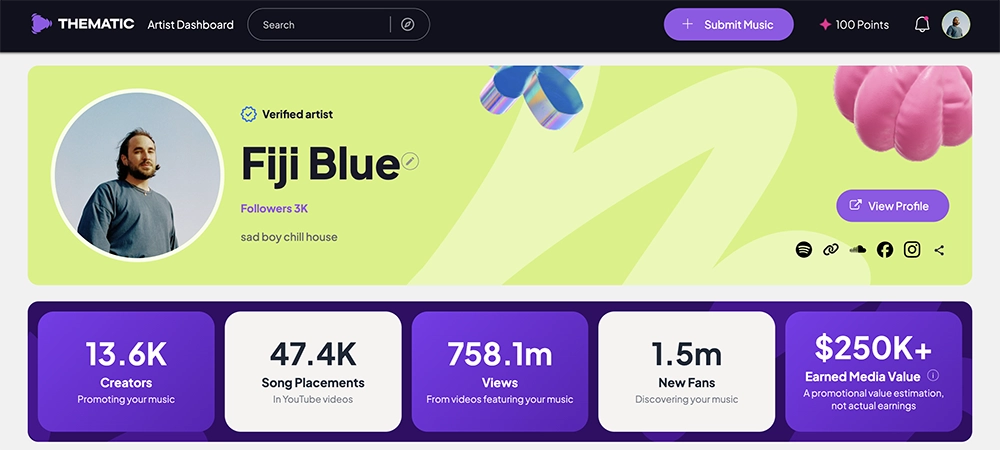
98% of songs submitted to Thematic receive at least one creator video placement. Artists get a dashboard showing which videos feature their music, which audiences are discovering them, and how their streams are trending. No manual outreach, no campaign budget, no lost royalties.
How to Submit Music to TikTok Influencers
TikTok is where influencer music marketing moves fastest. A song that connects with the right creator can go from unknown to everywhere in a matter of days – not because of an algorithm push, but because TikTok creators replicate sounds and trends at a speed no other platform matches. When a track gets used in one trending video format, hundreds of creators make their own version.
For independent artists, this makes TikTok one of the highest-upside placements available – and one of the hardest to access directly.
The challenge with direct TikTok outreach: Most TikTok creators who would be a good fit for independent music aren’t actively looking for pitches. The ones who are often have formal influencer management and require payment. And unlike YouTube, where a creator can drop a license link in a description, TikTok’s licensing infrastructure is more restrictive about what music creators can use without triggering issues.
What changes with Thematic: Thematic is an official TikTok Commercial Music Library (CML) partner, which means songs in the Thematic catalog are pre-cleared for use by TikTok creators without copyright complications. When you submit your music to Thematic, you’re putting it in front of 1M+ creators that includes an active TikTok creator base – without having to pitch anyone individually.
If you want to submit music to TikTok influencers specifically, the most reliable path is making your music available through Thematic’s catalog rather than managing TikTok outreach on your own. The platform handles the licensing structure; creators discover your music when it fits what they’re working on.
See Music for TikTok for more on how Thematic’s TikTok CML partnership works.
Best Practices for Getting Placed
Getting into the right channels matters. What you do on your end determines how well those channels perform.
Make your music easy to license. Before you submit to any platform, confirm you own or control the rights. If you have co-writers, make sure everyone’s on the same page. If you’re signed to a label or have a publishing deal, verify what’s cleared for sync use. Complicated rights situations slow down or block placements entirely – and a licensing dispute after a placement is worse than no placement.
Submit at the right time. On Thematic, it takes 3-5 weeks from submission for a song to go live on the platform. The best time to submit is when you’re scheduling your release with a distributor – that way, your Thematic placements can start on the same day the song goes live on streaming platforms. Don’t wait until after the release to think about sync.
Prioritize production quality. Creators need music that sounds good in their content. That doesn’t require a major-label budget, but it does require professional mixing and mastering. A song that sounds amateur will get passed over regardless of how good the writing is. Landr is a solid affordable mastering option if you’re not working with a professional engineer.
Engage with creators who use your music. When a creator features your track, that’s a real connection worth building on. Like and comment on their video. Share it to your own social channels. Creators who feel like the artist noticed them are more likely to use your music again and to tell other creators about it.
Don’t submit your whole catalog at once. Submit focus tracks individually, each with its own window to gain traction. When multiple tracks are presented to creators simultaneously, attention gets divided. A staggered release approach gives each song its own campaign.
Submit Your Music to 1M+ Creators for Free
Influencer music marketing doesn’t have to mean cold outreach, paid campaigns, or giving up your rights. Thematic gives independent artists direct access to 1M+ content creators on YouTube, TikTok, and Instagram – with full licensing management, artist dashboard tracking, and zero cost to submit.
98% of songs submitted to Thematic receive at least one creator video placement. Your music could be in the next video someone shares with their whole audience.
Frequently Asked Questions
Common questions about influencer music marketing, how to pitch music to influencers, and how independent artists get their songs featured in creator content.
What is influencer music marketing?
Influencer music marketing is when independent artists get their songs placed in videos, livestreams, or social posts by content creators on platforms like TikTok, YouTube, and Instagram. Rather than paying for ads or radio play, artists reach new listeners through the creator’s existing audience. It’s one of the most effective discovery channels available to independent artists because it reaches listeners in a context they trust – the content they’re already watching.
How do independent artists get their music featured by influencers?
The four main approaches are: listing music as copyright-free (passive, no tracking), manual outreach to creators directly (time-intensive, low response rates), paid influencer campaigns (expensive, not practical for most indie artists), and platforms like Thematic (free, automated, with full licensing and tracking). For most independent artists, free platforms that handle the licensing infrastructure on their behalf are the most scalable starting point.
How do I submit music to TikTok influencers?
The most reliable path is submitting through a platform with official TikTok Commercial Music Library (CML) access, rather than reaching out to TikTok creators directly. Thematic is an official TikTok CML partner, which means songs in its catalog are pre-cleared for TikTok creator use. Once your music is in the Thematic catalog, TikTok creators in the community can discover and license it without any direct pitching.
How do I pitch my music to influencers manually?
Start by identifying creators whose content style matches the mood or genre of your music. Reach out with a brief, specific message – mention a specific video of theirs, explain why the music is a fit, and make it easy for them to access and license the track. Keep it short. Most creators who do consider pitches receive dozens of them; anything that reads as a mass outreach template gets ignored. If you go this route, have a licensing solution in place before the creator says yes – otherwise a copyright claim lands on their video and they won’t work with you again.
Why is sync licensing important for getting music featured by influencers?
Sync licensing legally authorizes creators to use your music in their content without risking a copyright claim or strike on their channel. Without a licensing structure in place, creators who would otherwise use your music often won’t – the risk to their channel is too high. Getting this right protects both you and the creator, and it’s the foundation for building ongoing relationships with the creator community.
How do I track where my music is being featured?
On Thematic, the artist dashboard shows which videos feature your music, which creators are using it, and how placement activity is affecting your stream counts. This visibility is what separates Thematic from the copyright-free approach – you’re not just releasing music into the void, you’re building a picture of which audiences are connecting with your music and which content niches are a natural fit.
Is paying influencers to promote music worth it for independent artists?
For most independent artists, paid influencer campaigns are too expensive relative to the return. Campaign costs on major platforms typically start at several hundred dollars per placement, and meaningful scale requires multiple placements. Free platforms like Thematic – which place music across hundreds of creator videos without a per-placement fee – tend to deliver more aggregate exposure at a fraction of the cost. Paid campaigns make more sense as a supplement once you’ve established a base of organic creator interest in your music.
Does getting music featured by influencers actually increase streams?
Yes – and the effect compounds. Artists on Thematic typically see around a 20% increase in Spotify streams after placement activity begins. The mechanism is audience breadth: a song that appears across many creator videos – even smaller channels – reaches different audience segments simultaneously. That cross-audience exposure is what creates the compounding effect. One large creator posting one video rarely moves the needle the same way that dozens of mid-size creators using a song consistently does.
Looking for more resources for independent artists? Check out Thematic’s Artist Toolkit for guides on music copyright, promotion strategies, and how to get your music featured by influencers.

This article on Influencer Music Marketing is brought to you by Thematic Director of Partnerships, Stephanie Leyva
Stephanie Leyva sits at the intersection of music artists and content creators. As the Director of Partnerships at Thematic, Stephanie has worked extensively with the artist and creator community on the site to ensure success digitally, on the platform, and support their initiatives.
Over the past few years, she has led numerous trending music-driven influencer marketing campaigns for “Glitter” and “Supalonely (feat. Gus Dapperton)” by BENEE, “Loneliness for Love” by Lovelytheband, “Checklist (feat. Chromeo)” by MAX and so many more. She’s worked alongside various labels such as Casablanca Records, Republic Records and Sony Music. Focused on empowering connections between content creators and music artists, Stephanie continues to lead the charge in innovative music discovery through social.
Stephanie is also the creator of the Bloom In Progress podcast – a podcast about personal growth, relationships and navigating life in your 20’s.